The importance of trade for jobs

The Brexit negotiations are entering a decisive phase, with leading UK business organisations saying they will not invest and must consider whether they relocate if there is no agreement on a transition phase and there is clear progress on trade talks. For its part the Tory Cabinet is deferring any discussion on its key aims for EU trade talks, despite the pretence it is clamouring for them to begin. Any decision on the desired new relationship with the EU would probably lead to Cabinet splits, so discussion is being avoided.

The potential damage to the economy and living standards can be gauged in terms of jobs. Chart 1 below shows the number of UK jobs that are directly dependent on exports. In OECD jargon, these are the totals of ‘domestic employment in the UK embodied on overseas final demand’. Continue reading →

Two key reasons for Corbyn’s stunning advance

This post first appeared on Socialist Economic Bulletin.

Under Jeremy Corbyn’s leadership the Labour Party has staged a stunning revival, prevented Theresa May achieving a landslide which she would have claimed as a mandate for ‘Hard Brexit’ and has caused a crisis of Tory government which will make it harder to make new cuts in public spending, apart from rising inflation. None of Corbyn’s opponents could have possibly achieved that outcome.

This point can be factually established in two ways. First, there is the record of the election campaign itself. None of Jeremy Corbyn’s internal or external opponents would have conducted anything like the same campaign or written anything similar to the manifesto that was produced. On the contrary, the tactic of Corbyn’s opponents was to ‘give him enough rope to hang himself’, believing that his programme would prove massively unpopular. Continue reading →

Tories want to drive living standards lower. Corbyn wants to end austerity

This article first appeared on Socialist Economic Bulletin.

During the current crisis the UK has experienced the longest-ever recorded fall in living standards. The biggest part of that fall is not the cuts to government spending, even though these have had severe effects. Instead the largest factor contributing to the fall in living standards is the decline in real wages. The Resolution Foundation calls this decade the worst for falling pay in over 200 years.

This fall has now resumed once more because of the combination of stagnation in wage growth and rising prices. The rise in prices is a Brexit effect, after the sharp devaluation of the pound following the referendum result in June 2016. It is ridiculous for Theresa May to suggest the falling pound and therefore the fall in real wages, is not the result of the Brexit vote. Continue reading →

Fall in wages has much further to run

Chancellor Phillip Hammond

The latest consumer price inflation (CPI) data showed a sharp acceleration in prices increases. This will have a negative effect on real wages and real incomes, once inflation is taken into account. Most workers are facing flat wages and the poor, who rely on social welfare and are seeing freezes or cuts, will all be poorer as a result. Even worse, economic trends suggest that this problem will deepen.

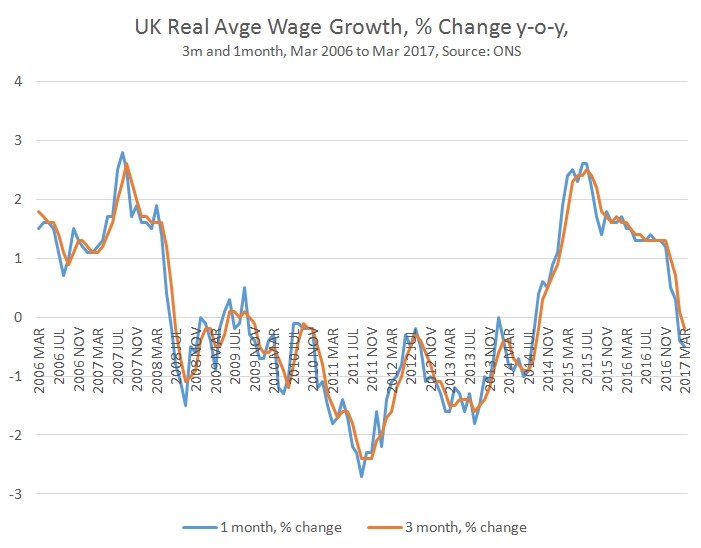
Chart 1 below shows the medium-term trend in real wages. It uses single month data rather than the more customary rolling 3-month average data highlighted by the Office for National Statistics (ONS) to smooth out monthly fluctuations. However, the single month data can be superior in identifying key turning-points. As the chart shows, it seems likely we have entered a key turning-point, with a sharp downturn. Continue reading →

Why are real wages falling?

Real wages are falling once more. In addition, nominal wages have fallen in the last 2 months which is highly unusual. Both of these developments are Brexit effects and the situation is likely to get worse as Brexit unfolds.

The trends in both real (inflation-adjusted) and nominal wages are shown in Chart 1 below. Real wages peaked in April 2008. A very large gap then opened up between real and nominal wages following the crisis, as nominal wage growth slowed and inflation subtracted from real wage growth.  But as the chart shows, it is rare for nominal wages to fall, and this has contributed to a marked recent drop in real wages. Continue reading →