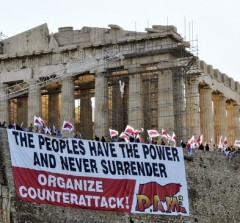
 One of the most remarkable facts about the British public’s attitude to prolonged austerity is the lack of the kind of open revolt which has been seen in so many other countries. In Greece it has led to the dramatic rise of Syriza under the dynamic leadership of the radical Tsipras who now has a poll rating ahead of all the other parties, including the government. In Spain the resistance led by originally the indignados has crystallised into a new party named Podemos which was formed only 10 months ago, but now is equally challenging the government. In Italy the prime minister Renzi has achieved the highest rating for his Democratic Party (39%), but second is the party of the comedian Beppe Grillo in the mid-20s%, well ahead of Berlusconi’s Forza Italian on 15%. So where is the equivalent in the UK? Continue reading
Tagged with Die Linke

European elections: A rising left amid the far right danger
 If you base your assessment of what’s going on politically in Europe on the BBC coverage of the Euro elections, you’ll be aware of the massive victory of the Front National in France and not too much else. The parallel rise of the far left was under-reported and where it was covered, the preferred terminology was ‘far right and eurosceptic parties’. Commentators seemed allergic to talking about a left victory. But left victory there was too.
While the big story was the shocking victory of Marine Le Pen’s party – the Front National moved from 6.34% in the 2009 Euro elections to 24.95%, a quadrupling of the vote – Syriza, the Greek radical left party, saw an even greater increase in its support. From 4.7% in 2009, it reached 26.55%, emerging almost 4 points ahead of its nearest rival, the rightwing New Democracy. Continue reading
Share:

Radical left could become third force in EU parliament, polls show
 The radical left could become the third force in the European parliament, after the conservatives and social democrats, according to recent polls.
Syriza in Greece leads with 26.2 % support, followed by Portugal, Spain and France. With a month to go to the European Parliament elections, polls suggest the Parliamentary Group of the European United Left (GUE – NGL) could increase the number of MEPs from 35 members to between 50 and 60, potentially overtaking the liberals (ALDE).
Led by Greece’s opposition leader Alexis Tsipras, the biggest gains for the radical left will be in southern Europe, led by Greece where all projections show his party Syriza in the lead. According to Pollwatch, which compiles European surveys in all member states, the Greek coalition stands as the first force in Greece with 26.2 %. Continue reading
Share:

Germany: Why the Left numerical majority isn’t a political majority
 Il Manifesto newspaper interviews Sahra Wagenknecht, deputy leader of Die Linke, on why Merkel did so well in the elections, the failure of the SPD and the prospects of unity on the Left.
For Sahra Wagenknecht, deputy leader of Die Linke (‘The Left’), there is no doubt: the weakness of the Social Democratic challenger was one of the determining factors to promote the Chancellor. ‘Peer Steinbrück could not represent an alternative: he embodies a series of bad choices, from the bank bailout to the increase in VAT, made when he was minister in the Grand Coalition [government] of 2005-2009,’, argues the 44 year old leader, figurehead of the most radical component of the party.
Against the backdrop of the christian democrat (CDU-CSU) victory, how do you judge the result of Die Linke ? Continue reading
Share:

Left Unity? No thanks, at least not yet
 The initiative by Left Unity (LU) to found a new party of the left (NPL) is the most serious attempt to do so for some years, and merits some consideration. I would like to argue that a NPL should not be formed, at least at least not now, as it is unlikely to succeed and could actually have counterproductive effects.
The implosion of the Communist Party (CPGB) in 1990, up until then the largest party of the left other than Labour left a few small grouplets, only one of which is now of any size (the Communist Party of Britain, which still, amazingly, manages to publish the Morning Star). Continue reading
